
Does a sharp or burning pain on the outside of your hip keep you awake at night? Most people know this as hip bursitis. You may also have heard it called trochanteric bursitis, lateral hip pain, or by its current clinical name, greater trochanteric pain syndrome (GTPS).
At the Clinic at Borde Hill in Haywards Heath, persistent lateral hip pain is assessed and managed by Dwaine Ford, our lead practitioner for Extracorporeal Shockwave Therapy (ESWT).
Hip bursitis, trochanteric bursitis and GTPS — what the names mean
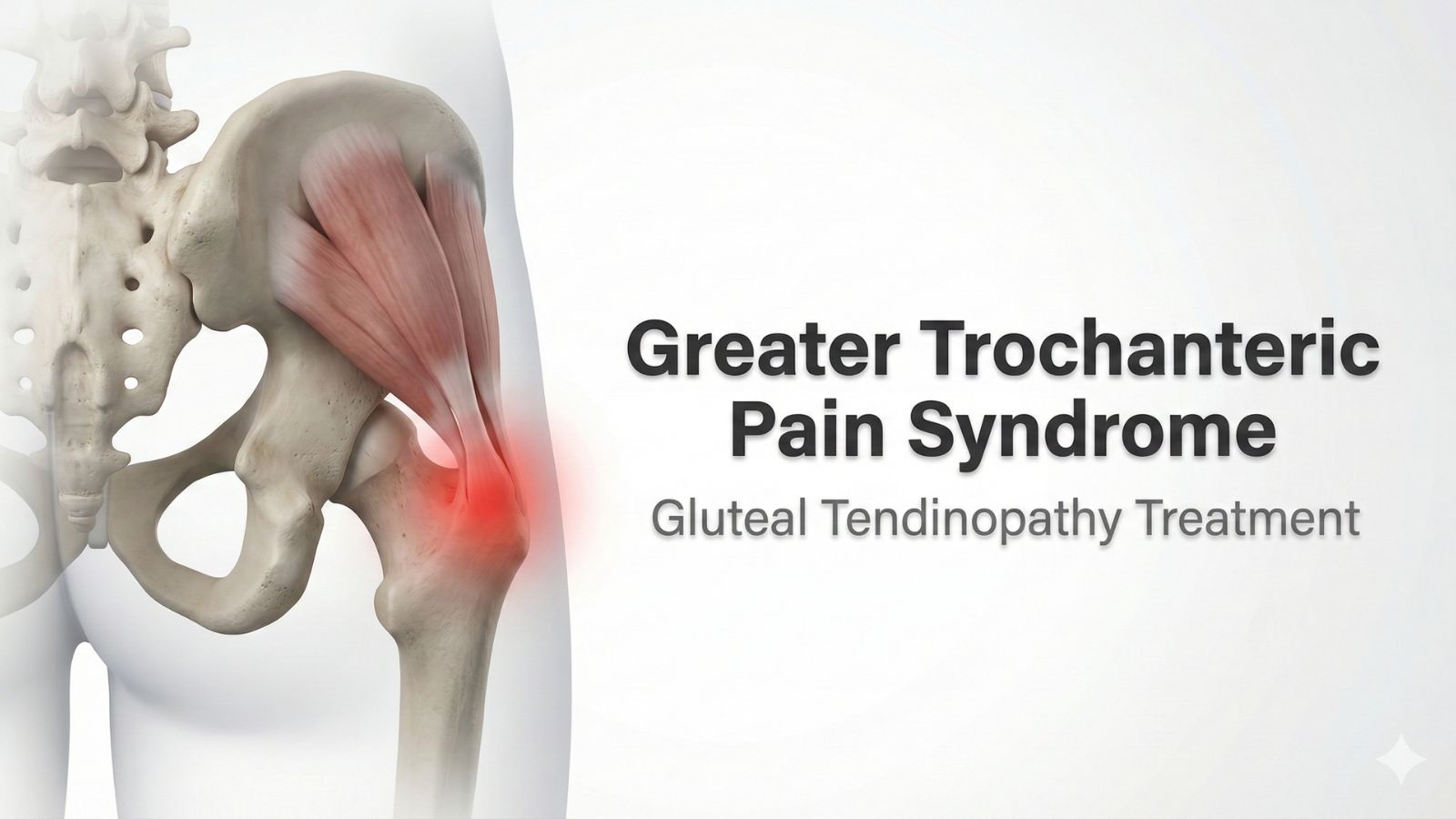
These names describe pain in the same place, but they are not interchangeable, and the difference is worth understanding before you read any further.
The greater trochanter is the bony bump you can feel on the side of your hip. Sitting over it are fluid-filled sacs called bursae, and for many years pain in this spot was diagnosed as hip bursitis or trochanteric bursitis — meaning inflammation of one of those sacs. It remains the term most people use.
Greater trochanteric pain syndrome is the current umbrella term for pain and tenderness over the greater trochanter. It came into use because modern research shows that in the vast majority of cases the pain is not driven by an inflamed bursa at all, but by gluteal tendinopathy — a breakdown in the tendons of the gluteus medius and gluteus minimus muscles, where they attach to the bone.
So the older name is not wrong, just narrower than what is usually going on. A bursa can genuinely be irritated, and often is, but it tends to be part of the picture rather than the whole of it. Tendon tissue and bursal tissue are different things, which is why what is involved in your own hip is better established at assessment than assumed from whichever label you arrived with.
Symptoms of hip bursitis (lateral hip pain)
Common signs include:
- Night pain. The most common complaint — being unable to sleep on the painful side, and often finding it painful to lie on the unaffected side too, because the top leg drops across the body.
- Localised tenderness. The bony prominence on the side of the hip is very tender to touch.
- Pain with activity. Standing on one leg, climbing stairs, or walking up hills.
- Referred pain. The ache can radiate down the outside of the thigh towards the knee.
- Pain when crossing your legs, or sitting for a long stretch with your knees together.
It is worth seeking an assessment if the pain is disturbing your sleep, or stopping you walking the distance you normally would.
Causes and risk factors
Three risk factors are recognised in lateral hip pain:
- Hormonal changes. It is most prevalent in women aged 40 to 60, as changing oestrogen levels can affect tendon health.
- A rapid increase in load. Suddenly taking up running, or significantly increasing your walking distance, asks more of the gluteal tendons than they are currently prepared for.
- Biomechanics and posture. Weak pelvic control — the hip dropping as you walk — or habitually standing with one hip pushed out, hanging on that hip. Both positions bring the leg across the midline and press the tendon against the bone.
That last point is also why the pain is so often at its worst in bed. Lying on the painful hip presses directly on the tendon, and lying on the other side lets the top leg fall across and compress it from the opposite direction.
How lateral hip pain is assessed

Not every painful hip is a gluteal tendon problem. A clinical assessment is used to differentiate GTPS from other causes of pain in the same area, including hip osteoarthritis and referred pain from the lower back — conditions that can feel similar to you but call for a different plan.
Dwaine Ford is a highly experienced musculoskeletal practitioner with a specialist focus on chronic pain and persistent injuries, and particular expertise in the management of lower-limb tendinopathies, including the gluteal tendon pain associated with GTPS. He is the clinic’s lead for Extracorporeal Shockwave Therapy. You can read more about Dwaine here.
What treatment involves
Gluteal loading programmes. Much of the work is exercise-based: specific isometric and strengthening protocols, designed to enhance the gluteal tendons without irritating the bursa.
Shockwave therapy (ESWT). For persistent or calcific cases, Extracorporeal Shockwave Therapy may be used alongside the loading programme. It is non-invasive. How shockwave works, how many sessions a course usually involves, the fees, the possible side effects and the contraindications are all set out on our shockwave therapy page.
Sleep and posture advice. How you lie in bed and how you stand both affect how much the tendon is compressed across the day and night, and you will be shown positions intended to reduce that.
Where to find us
The Clinic at Borde Hill is at Naldred Farm Offices, Borde Hill Lane, Haywards Heath, West Sussex RH16 1XR, with ample free parking right outside and disabled access. We serve patients from Haywards Heath, Lindfield, Cuckfield, Burgess Hill and Balcombe, and from across West Sussex including Crawley, Horsham and East Grinstead.
Frequently asked questions
Is hip bursitis the same as greater trochanteric pain syndrome?
They are closely related, but not identical. “Bursitis” names inflammation of the bursa as the problem, while greater trochanteric pain syndrome is the broader term now used, because in most cases the gluteal tendons are involved as well as, or instead of, the bursa. Which of the two is driving your own hip pain is a question for assessment.
Can I still walk with hip pain?
Usually yes, but it helps to think in terms of a pain budget. The general advice is to stay active while avoiding the hills or the walking speeds that spike your pain, and part of the assessment is working out where your own safe zone sits.
How do I stop the pain at night?
Try sleeping on your back with a pillow under your knees, or on your good side with a thick pillow between your legs to keep the top hip level. The aim is to keep the painful tendon from being stretched and compressed across the midline while you sleep.
When should I see my GP instead?
Lateral hip pain is common and is usually a soft-tissue problem, but some symptoms need medical assessment rather than manual therapy. Contact your GP, or call NHS 111, if your hip pain began with a fall or a significant injury, if you cannot put weight through the leg, if the hip is hot or swollen or you are feverish, or if you have unexplained weight loss, or numbness or weakness in the leg.
Is shockwave therapy suitable for everyone?
No. There are recognised contraindications — conditions and medications that rule it out — and they are listed in full on our shockwave therapy page, along with the possible side effects. It is worth reading both before you book.
How many sessions will I need, and what does it cost?
Session numbers and current fees for new patient and follow-up appointments are published on our shockwave therapy page.
Book an assessment
If you are struggling with lateral hip pain that sounds like this, you can request an assessment with Dwaine using the contact form on this page, or by calling 01444 616797. You can also email info@clinicatbordehill.com.